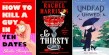





Fiction in translation famously comprises a small corner of the market, but if readers seem more interested in it these days, says Daniel Seton, editorial director at Pushkin Press, some of the credit may belong to a different medium entirely. “People have begun to routinely watch foreign-made programs with subtitles,” he explains. “They don’t see it as something weird or unusual. I think that’s helped make people more open to translated fiction—it’s no different from watching Squid Game or Shōgun.”
Historically, translated works have been particularly successful in the mystery and thriller genres. (Looking at you, Lisbeth Salander.) Advocates for international crime fiction see these books not as something niche but, as Seton puts it, “great stories that happen to have been written in another language.”
Target Acquired
Pushkin Press launched Pushkin Vertigo, a home for crime fiction from around the globe, in 2015. Japan, Seton notes, has a rich history of crime fiction that’s reminiscent of British and American traditions—Edgar Allan Poe, Agatha Christie, Arthur Conan Doyle. “It’s recognizably familiar, but it’s also original and exciting,” he says. “What’s distinctive about Japanese crime fiction is the inventiveness of the plots.”
One of the first releases from Pushkin Vertigo was The Tokyo Zodiac Murders by Soji Shimada, translated from the Japanese by Ross and Shika Mackenzie. PW’s review at the time said that the “intriguing first novel blends metafiction with a locked-room mystery.” More recently, The Man Who Died Seven Times by Yasuhiko Nishizawa, translated from the Japanese by Jesse Kirkwood, was a Barnes & Noble August mystery pick and a PW bestseller; the time-loop murder tale “stitches elements from Clue, Groundhog Day, and Toshikazu Kawaguchi’s Before the Coffee Gets Cold into a mischievous tale that stands on its own two feet,” per PW’s review.
HarperVia’s Japanese titles include artist and YouTuber Uketsu’s mystery-horror hybrids Strange Pictures and Strange Houses, both of which pubbed earlier this year and were translated by Jim Rion. PW’s starred review of the first called it “part police procedural and part Pictionary.” Judith Curr, president and publisher of the HarperOne Group, says the books “have clues and drawings that you have to decipher as you go through. You, the reader, become detective. You become involved in the book in a new way.”
Since HarperVia launched in 2018, the imprint, which focuses almost exclusively on fiction in translation, has published 167 titles from 30 countries and in 22 languages. “We started with a map of the world,” Curr says, and the imprint has been filling in the blanks ever since. “We didn’t have anything from Eastern Europe, so now we have The Lack of Light by Nino Haratischwili from Georgia, and Andrey Kurkov in Ukraine and his mystery series,” Curr says. “It’s important for people not to think of translation as having its moment—it’s actually years in the making.”
A forthcoming German-language translation from Soho Crime, Murder Mindfully (Apr. 2026), written by Karsten Dusse and translated by Florian Duijsens, has already been adapted as a Netflix series. “A lot of the things we’re drawn to tend to be very cinematic,” says Taz Urnov, an editor at Soho Press who acquires for Soho Crime. “The book was a bestseller in Germany, and the Netflix adaptation already existed when the book was sold to Faber,” which published Duijsens’s translation in the U.K. in January.
“When an author is such a success in their home country, it’s interesting looking at how that’s going to translate, no pun intended, to success in the United States,” Urnov says. “So with this shiny German Netflix adaptation in hand, we’re seeing how that adds to the book’s appeal in an American market.”
Soho Press’s crime imprint, Soho Crime, debuted in 1991 and is dedicated to imports; the imprint’s first work in translation was Seichō Matsumoto’s Inspector Imanishi Investigates, translated from the Japanese by Beth Cary. (For more about Matsumoto, see Amor Towles on Seicho Matsumoto.) In the years since, Soho Crime has published works translated from languages including Catalan, Czech, Danish, and Italian, set in countries from Iceland to Argentina and beyond. “If it’s a location that’s unfamiliar to you, you’ll learn about it,” Urnov says. “If it’s a location that’s familiar to you, you’ve never seen it like this.”
For instance, the tech thriller Jackson Alone by Jose Ando, translated from the Japanese by Kalau Almony (Soho Crime, Jan. 2026), centers on four gay, half-Black Japanese men in Tokyo. PW’s review, though mixed, noted, “It’s hard not to admire the author’s passionate rebuke of Japanese conformity or his tender depiction of queer camaraderie.”
Almony brought Ando’s novel to Soho Crime, and Urnov says it represents the kind of title the imprint is looking for: an “audacious, boundary-pushing treatment of marginalized groups. The translators know what we do well, and they come to us with projects that they think we’ll be excited about.”
Genre unconventions
Catapult editor-in-chief Kendall Storey credits her imprint’s deep roster of books in translation in part to a trusted stable of translators who, she says, can be a book’s “best advocate.” Kira Josefsson, who translates between Swedish and English, suggested Hanna Johansson’s 2024 debut, Antiquity, to the imprint; PW’s review called it “a moody exploration of loneliness and obsession.” Josefsson also championed and translated Johansson’s follow-up, Body Double (Catapult, Apr. 2026), a queer love story within what’s billed as a Hitchcockian literary thriller: two women meet by chance in a café, accidentally exchange coats, and form a romantic attachment that takes on sinister undercurrents as one remakes herself in the other’s image.
“Catapult publishes literary fiction including books that play with genre and turn it on its head in some way,” Storey says. “Body Double is a thriller, but the mystery at its center is existential.”
Putnam recently released Menu of Happiness, the third volume in Hisashi Kashiwai’s Kamogawa Food Detectives culinary mystery series. In the books, which were translated from the Japanese by Jesse Kirkwood, a retired police detective and his daughter run a restaurant that helps patrons recover lost memories through food. It’s an example of the Japanese healing fiction trend—think We’ll Prescribe You a Cat or Days at the Morisaki Bookshop—with a cozy mystery spin.
Healing fiction “doesn’t have to take place in a bookstore, and it doesn’t have to include a lot of cats,” says Tara Singh Carlson, VP and executive editor at Putnam (notwithstanding the cat featured prominently on each Kamogawa cover). “It’s more about the feeling—nothing really horrible is going to happen.”
Along those lines, Masateru Konishi’s debut, My Grandfather, the Master Detective (Putnam, Mar. 2026), translated from the Japanese by Louise Heal Kawai, is a cozy mystery that centers on a schoolteacher and her grandfather. He suffers from dementia, but as a former member of the Waseda Mystery Club, he retains a sharpness that helps the pair solve everyday mysteries. “I was really interested in what the author was doing with the relationship,” Singh Carlson says. “You’re looking to find out what happens in the mystery, but the experience of it has that cozy, healing feel.”
She notes that while it’s satisfying to visit a bookstore and find a table dedicated to Asian fiction, “Japanese translated fiction is very saturated at this point. Finding something that feels a little bit different is getting harder.” With their recent and forthcoming mysteries and thrillers in translation, Singh Carlson and others PW spoke with are sharing novel discoveries.
Elaine Aradillas is a journalist and author based in San Antonio, Tex.
Read more from our Mysteries & Thrillers in Translation feature.
Amor Towles on Seicho Matsumoto