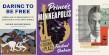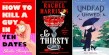





Welcome to the weird, weird West. Genre-blending, bananas Bonanza tales were a wildly fun trend for graphic novels in 2025. Western settings conjure adventure, escapism, romance, and small towns populated with loners and oddballs, all with a sense of danger often lurking beneath the big skies. These comics kept those wagon tropes rolling, sometimes right up to the brink and off the cliff of reality. Queer centaurs ride through a Cormac McCarthy-styled adventure, a SxSW road trip goes awry, and a cowboy loves (and hates) a samurai in these comics picks.
 Buff Soul
Moa Romanova, trans. from the Swedish by Melissa Bowers. Fantagraphics, $29.99 (240p) ISBN 979-8-87500-068-3
Eisner winner Romanova follows Goblin Girl with another exceptional autofiction, this time set amid the hedonism of Austin’s SXSW festival. Nursing a hangover, Moa vows to “take it so damn easy” in Austin, but relaxation isn’t on the itinerary with her friends and travel partners Åsa and Lina, whose band Shitkid is playing the festival. Hosted by 1980s–1990s alt-rock luminaries turned middle-aged dog dads (including King Buzzo, frontman for The Melvins), the trio plunges headlong into afterparty excess, with side trips to a desert shooting range and a rodeo. Things escalate when they connect with Dylan, a guy from Åsa’s past with a heroin habit. Moa’s inevitable comedown—tears, puke, a possible concussion, and a “massive shame tsunami” following a threesome—dredges up still-raw grief over a friend’s death and forces her to reassess the “self-imposed chaos” in her life. Romanova’s SweeTarts-hued Austin skylines evoke Art Deco and faded Trapper Keepers crossed with Ralph Nagel posters, while her distinctive character designs—long-limbed, elven-faced, with outsize honey bun ears—perform expressive marvels. Amid her candid reckoning with addiction and anxiety, Romanova is also bracingly witty, with nimble banter and blunt punch lines delineating the highs and lows of her central characters’ fierce friendship. Over a winding trail of vomit, snot, and tears, Romanova’s girls stumble toward messy but clear-eyed self-recognition. Like the title suggests, this one has spirit to spare. (Aug.) The Butcher’s Boy
Landry Q. Walker and Justin Greenwood. Dark Horse, $19.99 trade paper (136p) ISBN 978-1-5067-4161-1
Cannibalistic body horror meets cosmic terror in this juicy feast of fear from Walker (The Last Siege) and Greenwood (the Stumptown series). Six bickering friends in search of an offbeat vacation pull up to a sleepy western town that was terrorized 100 years ago by a serial killer called the Butcher of the Silver Mines. (“It’s folk horror. Very popular right now,” the most online member of the group assures the gang.) After sampling the local diner’s burgers, they experience hunger, hallucinations, and worse. In classic horror fashion, when they try to escape, their car won’t start. Flashbacks fill in the characters’ backstories, while in the present, their relationships, minds, and bodies disintegrate. As the terror ratchets up from cannibalistic killers to vaster and stranger threats, Walker’s script draws from H.P. Lovecraft and his acolytes, including Laird Barron, while Greenwood’s dynamic, character-focused art has an off-kilter edge reminiscent of ’90s indie artists like Sam Kieth. Deep shadows and close-ups of meat and teeth create a menacing mood from the start. Readers with an appetite for splatter will be satisfied. (Jan.) Falling in Love on the Path to Hell
Gerry Duggan and Gary Brown. Image, $9.99 trade paper (112p) ISBN 978-1-5343-2883-9
This pulsating, blood-soaked slow-burn romance from writer Duggan (the Deadpool series) and artist Brown (the Massive series) joyfully remixes tropes from the samurai and western genres. Amid vigorous head-loppings, brain-splattering six-shooter action, and sword-and-spear clashes against zombie hordes, each staged and colored with sickening power, this series kickoff favors pared-down storytelling and archetypal characterization. In 1877, on opposite ends of the earth, a revenge-driven male cowboy and a defeated but incapable-of-surrender female samurai fight their doomed battles to the death, linked by smart cross-cutting and twilight imagery. Both awake with the “corpse tide” on a deserted island where other dead warriors assemble each night to fend off ravenous ghouls. As the protagonists acclimate to the afterlife and slowly discover each other’s elemental powers, Brown’s nimble, inventive layouts capture the passage of otherworldly time. Amid the plethora of battles, every decapitation is an event. Notably, though, some grindhouse conventions are upended, such as a scene of attempted rape in which the woman saves the man. More familiar are new agey hints about the mysteries of the island—perhaps inevitably, redemption is a theme. This gritty-but-heartfelt genre mash-up embraces the medium’s freedoms and possibilities without pretension. It’s perfect for readers who favor red meat and formal rigor. (Jan.) Hotblood!
Toril Orlesky. Mad Cave, $19.99 trade paper (240p) ISBN 978-1-5458-2044-5
Orlesky’s darkly romantic debut, first serialized online, conjures a gritty Weird West where centaurs gallop across the American frontier and sphinxes take out bounties. Evander Rook, a cynical, scarred centaur and soldier of fortune, crosses paths with fast-talking human opportunist Asa Langley, who works for an East Coast steel baron and hopes to strike it rich in the Wyoming Territory. “Asa was crazy enough to eat the devil with horns on,” Evander complains, but as they travel together, the two become partners, lovers, coconspirators, and deadly enemies. An epigraph from Cormac McCarthy’s Blood Meridian foreshadows the book’s bitterly elegiac tone, though it’s hard to miss the influence of Annie Proulx and Brokeback Mountain as well. The fantasy elements coexist within a realist American West of sunsets and smoke-filled skies, a troubled land being parceled out in “deals made so low under the table it was closer to romance than business.” Orlesky drapes desert vistas, frontier towns, and foreboding industrial zones in warm sepia tones and organic textures that the characters, human and inhuman alike, seem to inhabit naturally. Pulled off with attention-demanding originality, this cross-genre epic will rope in fans of historical fiction and romantasy that doesn’t guarantee a happily ever after. (Sept.) Photographic Memory: William Henry Jackson and the American West
Bill Griffith. Abrams ComicArts, $35 (288p) ISBN 978-1-4197-8414-9
Zippy the Pinhead creator Griffith (Three Rocks) presents a sprightly graphic biography of his great-grandfather, photographer William Henry Jackson, who died in 1942. Griffith, who was shocked to see one of his great-grandfather’s pictures in his high school textbook as a teenager in the 1950s, replays Jackson’s life through an imagined conversation between an elderly Jackson and a visiting friend. The Eisner winner’s trademark cross-hatching neatly fits the narrative’s largely 19th-century setting. Self-taught in the nascent art of photography, Civil War veteran Jackson first specialized in portraits. He wandered the frontier for years, working for railroads that paid him to shoot the sights of the West as it opened to tourism and settlement. Jackson’s signature achievement—taking the first photographs of Yellowstone, which helped convince Congress to protect it as parkland—is detailed along with images from the Mesa Verde cliff dwellings, Korea, and Afghanistan. Aside from an idiosyncratic nod to Yogi Bear (and a jokey suggestion that a 1904 Jackson photograph from Coney Island captured “a distant relative of Zippy”), Griffith plays this story straight; occasionally it can feel dutiful. Still, it’s an immersive and thoughtful examination of an innovative American artist. (Oct.) Time Waits
Chip Zdarsky et al. Dstlry, $30 (152p) ISBN 978-1-962265-16-4
This cleverly plotted sci-fi adventure from Zdarsky (the Daredevil series), cowritten by David Brothers (Good Devils) and with art by Marcus To and Marvin Sianipa, follows the exploits of Blue Hardy, a stranded commando from the future. In the present day, Blue’s striving to make a good, simple life for himself—he’s married to town sheriff Grace, he’s about to adopt foster kid Duke Rowland, and he literally tends to his own garden. Then violent comrades from the future return, in search of mysterious botanical seeds that could save their world. While Blue’s wracked with “time sickness,” which plays havoc with his memories, Grace, Duke, and his gregarious friend Baker (“I’m trustworthy as hell, Sheriff”) rally to protect him. The narrative builds to an energetic climax set in the dystopian future, where aged versions of Blue’s allies save him from execution and undertake an 11th-hour quest to get him back home in the last remaining time machine. The suspense is balanced with naturalistic dialogue and humor, while the artwork swaps visual styles effectively. Zdarsky’s fans will relish this optimistic tale, in which keeping up with the complex time-travel antics pays off. (Apr.)Correction: A previous version of this review incorrectly stated that cowriter David Brothers also supplies art.