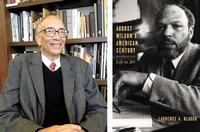
August Wilson’s American Century: Life as Art
Laurence A. Glasco. Univ. of Pittsburgh, $35 (416p) ISBN 978-0-8229-4854-4
Historian Glasco (coauthor of August Wilson) meticulously chronicles the life of 20th-century playwright August Wilson through the prism of his home city. Raised in Pittsburgh’s predominately Black Hill District but sent to parochial school, Wilson (1945–2005) grew up as something of an “outsider.” As a kid he cut class to read in the public library, and after graduation he wandered the city jotting down observations and conversation snippets that honed his ear for dialogue. After riots erupted in Pittsburgh following the assassination of Martin Luther King Jr. in 1968, Wilson became increasingly involved with the Black Nationalist movement and eventually cofounded the city’s Black nationalist theater, Black Horizons. Yet he remained true to “his own conception of what it means to be African American,” the author notes, eschewing a “stronger racial message” in his work for “confessional, apolitical poetry” that sometimes drew his peers’ ire. Later, his hometown inspired his famous Pittsburgh Cycle, including such hits as 1985’s Fences, which explored Black identity and ancestry as well as universal themes of love, duty, and betrayal. Drawing on interviews with Wilson’s former neighbors, classmates, and relatives, Glasco paints a richly detailed portrait of how the playwright’s relationship to his home—as both native son and outsider—shaped the settings and thematic preoccupations of his plays. It’s a fresh angle on the oeuvre of a preeminent American dramatist. (Feb.)
Details
Reviewed on: 11/25/2025
Genre: Nonfiction